

Beauty Uncompromised Request a Private Consultation


Medically reviewed by Dr. Karan Chopra, MD, board-certified plastic surgeon
The pulled, overdone facelift look comes from putting tension on the skin instead of repositioning the deeper structural layer of the face. A deep plane facelift avoids it by working one layer deeper, releasing the ligaments and repositioning the tissue so the skin is never pulled tight. Beyond technique, a natural result also depends on the surgeon's aesthetic eye. This is why two surgeons can perform the same operation and get very different results.
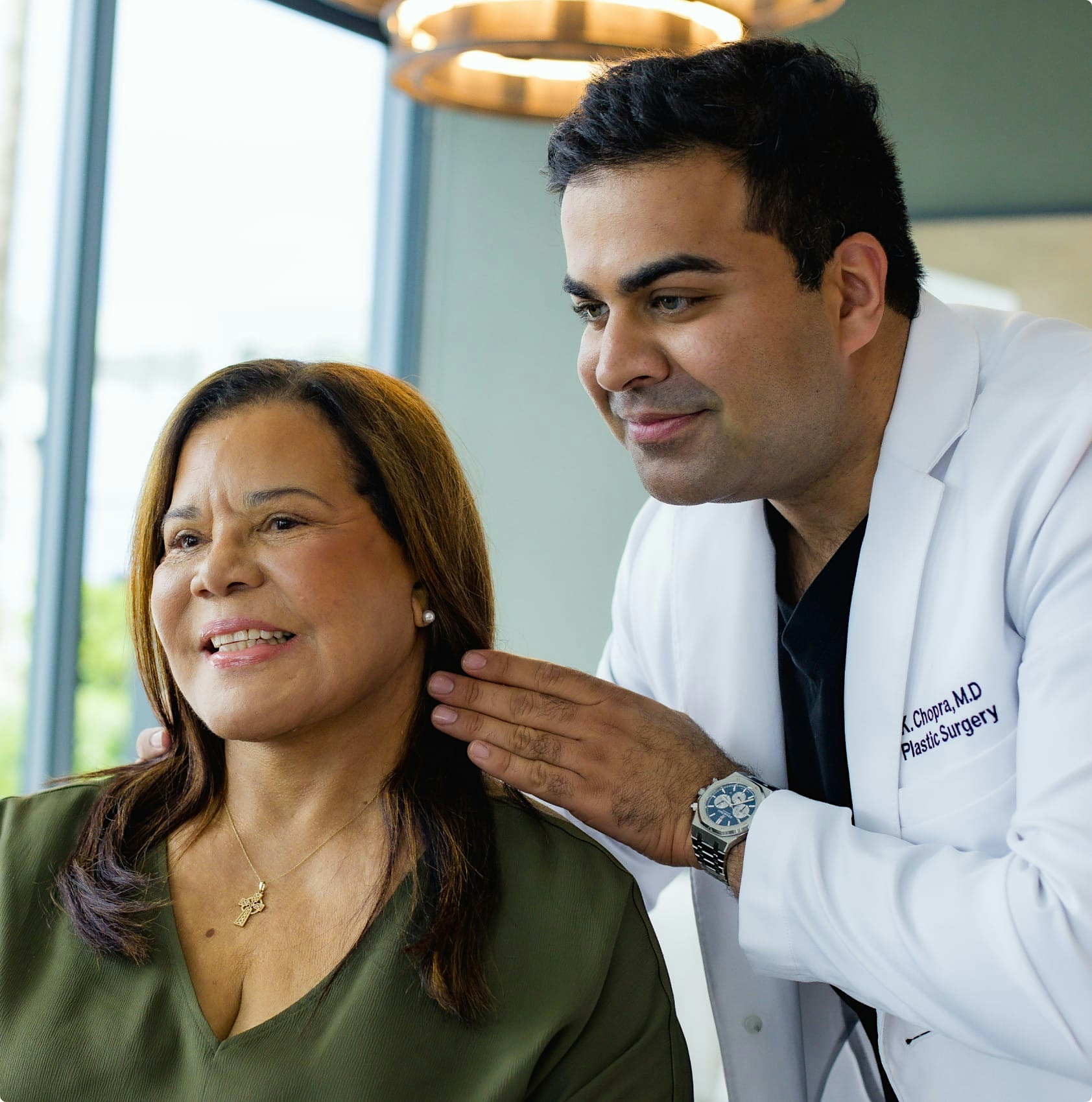
Dr. Karan Chopra is a board-certified plastic surgeon at Chopra Plastic Surgery in Miami who trained at Johns Hopkins and built his practice around facial and neck surgery. You can read more on his bio page. This article explains why some facelifts look fake, what actually causes the overdone look, how a deep plane facelift stays natural, and how to choose a surgeon for a result that still looks like you.
The overdone facelift look is a tight, pulled, or windswept appearance that results from loading the skin with tension rather than lifting the deeper structures of the face.
The fake, done look almost always traces back to one thing: tension in the wrong layer. When a facelift relies on pulling the skin tight, it flattens the natural surface of the face and creates a stretched appearance. Skin was designed to cover, not to carry the load of a lift, so pulling it taut looks artificial and does not hold well over time. Within months, a skin-only lift tends to relax again, much like skin stretched during pregnancy does not simply snap back.
Older facelift techniques did exactly this, and they are the source of the pulled reputation the procedure still carries. Modern technique moved the work deeper specifically to avoid it.
A pulled result usually shows a recognizable set of signs, and each one points back to a lift that loaded the skin instead of the deeper structures:
Scarring deserves a note of nuance. It is roughly half technique and half genetics, so even a well-done facelift can scar in a patient predisposed to it. But an over-tightened facelift stacks the odds against you, because a genetic tendency to scar is combined with skin closed under too much tension.
A deep plane facelift works beneath the superficial musculoaponeurotic system, the connected layer of muscle and fascia that the NIH National Library of Medicine describes in detail. Rather than pulling the skin, the surgeon releases the retaining ligaments beneath this layer and repositions the deeper tissue, so the skin simply redrapes over a restored foundation.
Because the skin is never the thing under tension, the soft contours of the face are preserved and the result looks rested rather than stretched. Dr. Chopra describes it as a biological reset that returns the anatomy toward its youthful position, which is why a well-done deep plane result is neither overdone nor underdone. Compared with a SMAS facelift, which tightens the muscle layer from above without fully releasing those ligaments, the deep plane approach tends to look more natural and last longer, with results that commonly hold for ten to fifteen years.
No, and this is the part patients rarely hear. Two surgeons can perform the same deep plane facelift and get different results, because a beautiful outcome also depends on judgment. Recognizing what does not look good is common. Creating something that genuinely looks beautiful requires an aesthetic sense developed through focusing on faces and performing a high volume of cases.
Vectoring is part of that judgment. The angle of the lift is planned for each face, and in men it is planned so the sideburn and beard-bearing skin are not shifted into areas that should not have hair. Small decisions like these are the difference between a result that reads as natural and one that announces itself.
Often, yes. A revision facelift using a deep plane approach lets the surgeon work in the correct layer, release the tissue, and re-elevate it with proper vectoring, which can soften a pulled appearance. How much can be improved depends on how much skin and tissue remain from the earlier surgery, because a previous lift that removed a great deal of skin leaves less to reposition. For that reason, revision results are assessed individually and expectations are set honestly.
Your best tool is the surgeon's own before-and-after gallery, if you know what to look for. Beyond the obvious improvement, check the details that reveal technique:
The profile view is often the most revealing, so ask to see several patients from the side, not just the front. Dr. Chopra is a Clinical Professor of Plastic Surgery at the University of Miami and Florida International University, and his practice is built around natural-looking facial and neck surgery.
If your biggest fear is looking done, the answer is a surgeon whose technique and eye both point toward natural results. Dr. Karan Chopra focuses his practice on natural-looking facial and neck surgery in Miami. Schedule your consultation with Dr. Chopra today. Consultations are available in person and virtually for out-of-town patients.
This article is for general education and is not medical advice. Individual results vary. Please consult a board-certified plastic surgeon about your specific situation.
Because they rely on pulling the skin tight, which flattens the face and creates a stretched, windswept look. Skin is meant to cover, not to carry a lift, so loading it with tension looks artificial and does not hold well over time.
A pixie ear deformity, a shifted sideburn or hairline, flattened cheeks, and widened scars are the common signs. Each points to a lift that placed tension on the skin instead of repositioning the deeper structures.
It tends to, because it releases the retaining ligaments and repositions the deeper tissue rather than pulling the skin. Preserving the natural contours of the face keeps the result looking rested rather than done, and it commonly lasts ten to fifteen years.
Often, yes. A deep plane revision lets the surgeon work in the correct layer and re-elevate the tissue with proper vectoring. How much can be improved depends on how much skin and tissue remain from the earlier surgery.
Look for a surgeon who focuses on faces, performs the deep plane technique, and whose before-and-after gallery shows natural results with untouched-looking earlobes and hairlines, especially in profile. Confirm they are board certified by the American Board of Plastic Surgery.