

Beauty Uncompromised Request a Private Consultation



Medically reviewed by Dr. Karan Chopra, MD, board-certified plastic surgeon
There is a wave of people getting facelifts younger, with patients in their early 40s, and even their late 30s, booking consultations in numbers surgeons have never seen before. Earlier can genuinely be better, but only if you meet specific criteria: some neck laxity, early jowling, forming nasolabial folds, and true excess skin. On the other end of the spectrum, no one is too old, because candidacy is decided by health, not by age.
Dr. Karan Chopra is a board-certified plastic surgeon at Chopra Plastic Surgery in Miami who trained at Johns Hopkins and built his practice around facial and neck surgery. You can read more on his bio page. This article explains why younger patients are choosing surgery, the four signs you are ready, a mirror test you can do at home, and whether anyone is ever too old for a deep plane facelift.
A deep plane facelift is a facial rejuvenation surgery that repositions the deeper structural layer of the face rather than pulling the skin, which is why it can look natural even in a younger patient with healthy, elastic skin.
The shift toward surgery in your 40s comes from a growing awareness of what non-surgical technologies actually do. Devices that heat the skin do not create a lift, and they do not reduce excess skin. What they can create is scar tissue that makes a beautiful facelift more difficult later.
Excessive filler carries its own drawbacks. Over time, too much filler can begin to masculinize an otherwise feminine face, and it can produce an overfilled look that many patients find objectionable. Dr. Chopra plans facial rejuvenation around one principle: sagging tissue needs a lift, not more volume. Once patients understand that, and understand that cooking the skin with devices does not lift anything, surgery in the 40s stops looking premature and starts looking like the honest answer.
Being in your 40s does not automatically make you a candidate. During a consultation, Dr. Chopra performs a full analysis and looks for four specific criteria:
All four matter. A 42-year-old with a tight neck, a clean jawline, and no skin excess is not ready, no matter how motivated they feel. A 42-year-old with early versions of all four is often an outstanding candidate, and the result at that age can be remarkable.
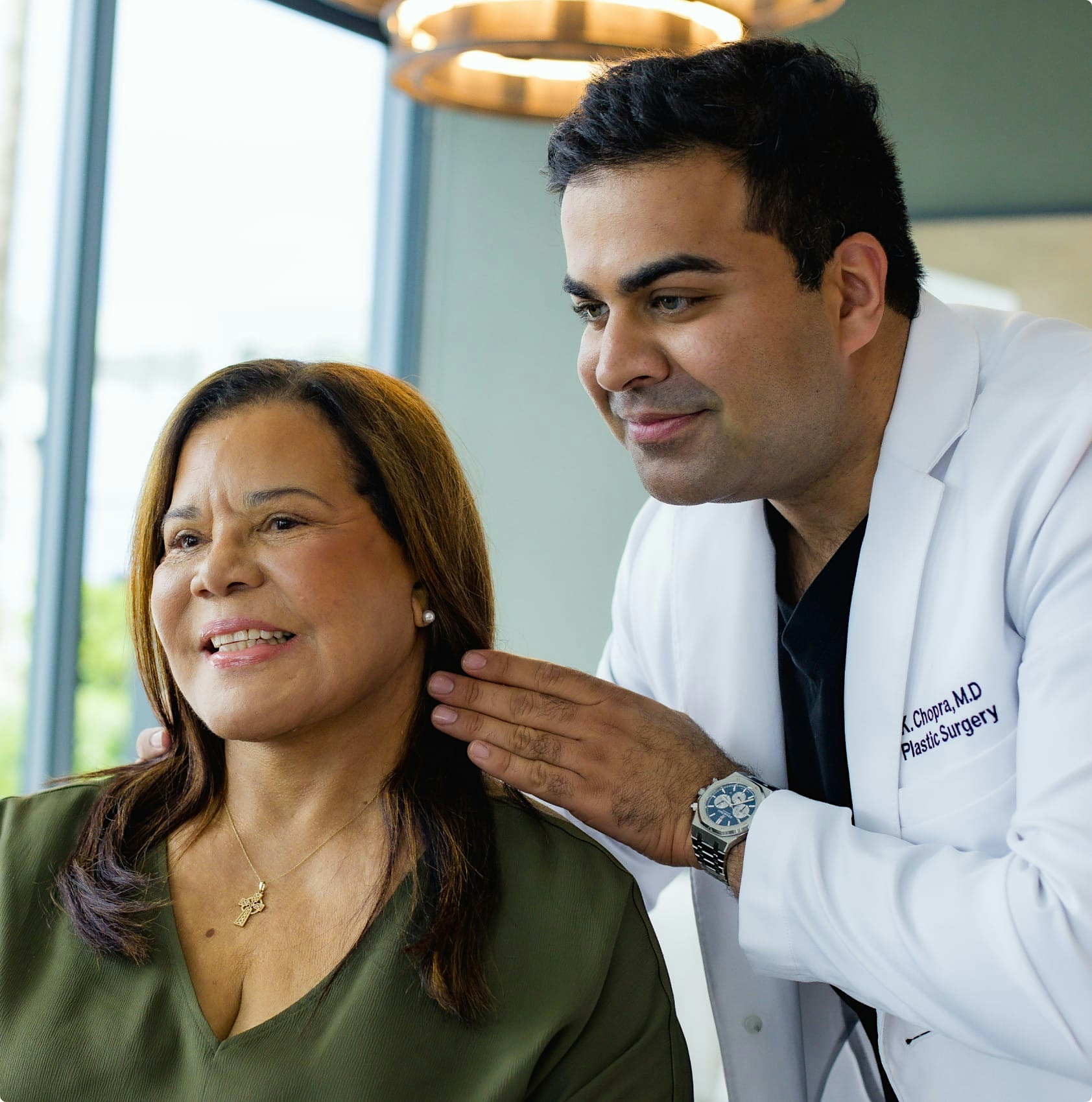
There is a simple test that tells you whether a consultation is worth booking. Stand at the mirror and gently pull the skin of your lower face and neck back with your fingertips, then watch for two things:
If both are true, you may be a great candidate for a deep plane facelift, and you are ready for a professional analysis. If pulling the skin changes nothing, your concern likely is not skin laxity at all, and a different plan may serve you better.
Dr. Chopra describes this age group as especially gratifying to treat, and the reason is everything that has not aged yet. In your 40s, eyebrow position is usually still good, lip volume is still good, and the eyelids tend to be holding up very well. Most importantly, the skin is soft, supple, and healthy, with a strong elastin layer, the protein the NIH National Library of Medicine describes as giving tissue its elastic recoil. Elastin is what lets skin redrape crisply over a new contour, and it thins with every passing decade.
That combination means a very targeted, focused plan involving just the face and neck produces a result that looks that much better. Nothing else needs correcting, so nothing else distracts from the outcome.
Surgery still works beautifully in the older age group, but the plan changes. By the 70s, the ears and earlobes have changed and the earlobes have lengthened, the brows have descended, and the elastin layer has thinned, so the skin does not snap over a new contour with the same power. That is why facelifts in older patients often become top-to-bottom plans: a brow lift, upper and lower eyelids, a lip lift, facial fat transfer, earlobe reduction, and laser resurfacing, all layered onto the face and neck work.
Doing the deep plane facelift and deep neck lift earlier lets you skip all of that for now. Those areas can be addressed naturally later, one at a time, as they actually age. Dr. Chopra also frames it as a value question: you want to enjoy this surgery for more time, so a lift performed in your 40s or 50s is a result you live with and benefit from for years.
No. There is no age contraindication to elective cosmetic surgery such as a deep plane facelift and neck lift. Candidacy comes down to health, and specifically to how well any medical conditions are managed. Poorly controlled diabetes rules surgery out, and so does poorly controlled high blood pressure. The same conditions under good control do not. A patient who is 70, 80, or even 90 can safely have surgery as long as they are otherwise healthy and their medical problems are managed.
Most of Dr. Chopra's facelift patients are in their 50s and 60s, with a growing group in their 40s and some who wait until their 70s. Every one of them starts at the same place: a thorough analysis with a surgeon who performs this operation every day.
This article is for general education and is not medical advice. Individual results vary. Please consult a board-certified plastic surgeon about your specific situation.
The best facelift is the one done when your face is actually ready, not the earliest possible date. Dr. Karan Chopra will give you a straight answer about your timing. Schedule your consultation with Dr. Chopra today. Consultations are available in person in Miami and virtually for out-of-town patients.
Not necessarily. If you have some neck laxity, early jowling, forming nasolabial folds, and true excess skin, your 40s can be an ideal time, because the brows, eyelids, lips, and skin quality are still at their best.
Pull the skin of your lower face back gently at the mirror. If the neck, jowls, and nasolabial folds improve and the skin bunches slightly toward the back, you may be an excellent candidate and ready for a consultation.
No. There is no age limit. Candidacy depends on health, and patients in their 70s and beyond can safely have surgery when medical conditions such as diabetes and high blood pressure are well controlled.
The skin still has a strong elastin layer, and the brows, eyelids, and lips have not yet aged, so a targeted lift of just the face and neck produces an especially clean, natural result.
No. Heat-based devices do not lift and do not remove excess skin, and repeated treatments can create scar tissue that makes a later facelift more difficult.