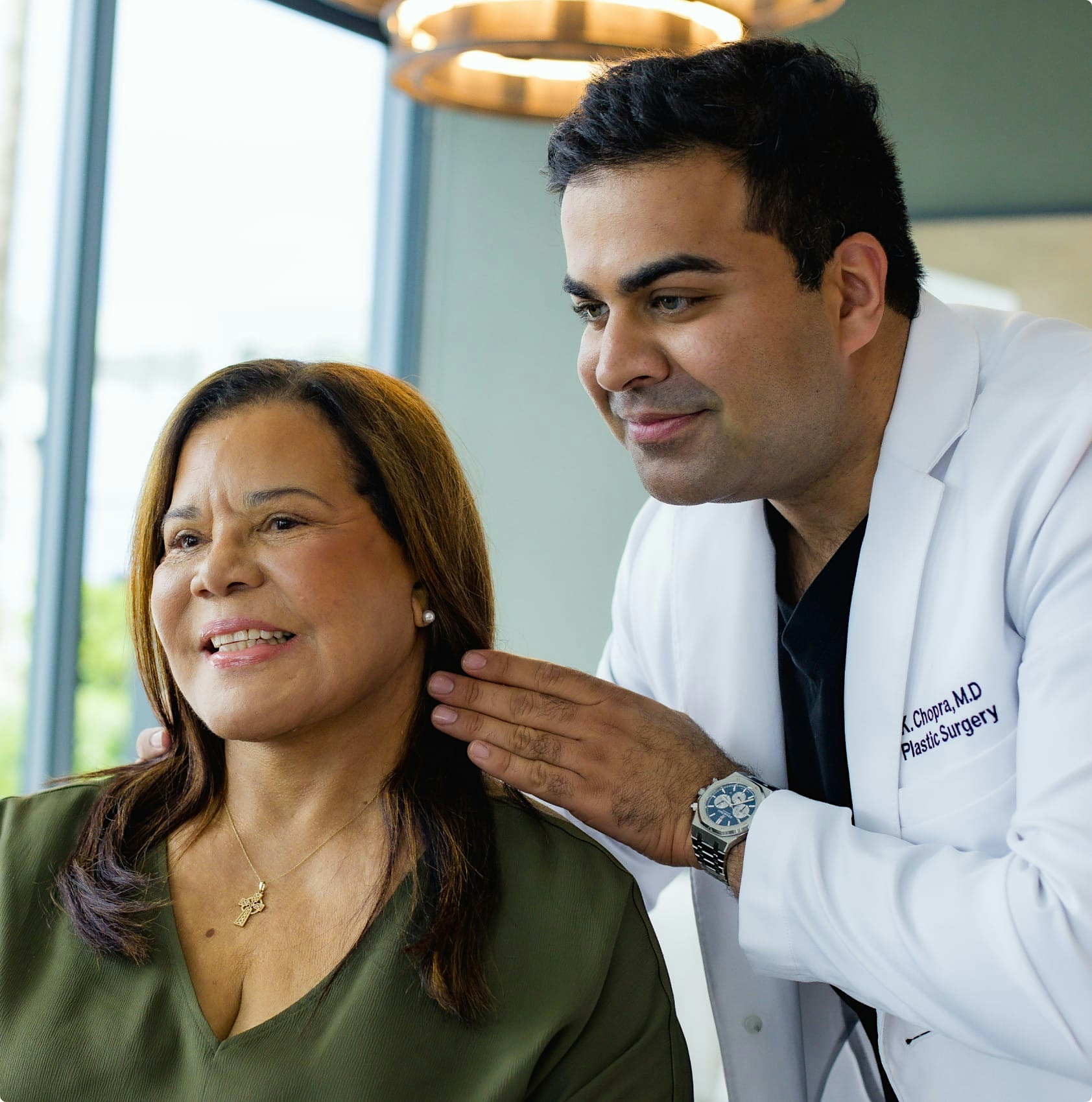


Beauty Uncompromised Request a Private Consultation

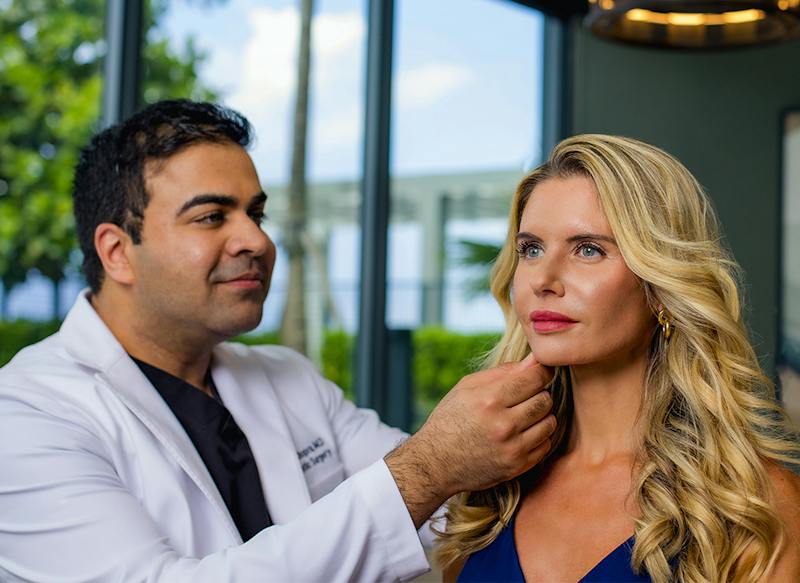
A good facelift consultation is an exam and a planning session, not a sales pitch. It starts with standardized medical photography, moves to a detailed exam of the face, eyes, and neck, and ends with you and the surgeon reviewing your own photos to map out what would improve. Here is what happens, and what to ask.
Dr. Karan Chopra is a board-certified plastic surgeon in Miami who trained at Johns Hopkins, with fellowship training in deep plane facelift and neck lift technique, and he serves as an Assistant Professor at the Herbert Wertheim College of Medicine at Florida International University. You can read more about his background on his bio page. This article explains what happens in a facelift consultation, step by step, and the questions worth asking before you let anyone operate on your face.
A facelift consultation includes standardized photography, a facial exam, a review of your anatomy and goals, and an honest assessment of whether surgery is right for you.
A consultation can happen two ways. An in-person visit is the fullest version, with photography and a hands-on exam. A virtual consultation by video is how many out-of-town patients begin, so they understand the plan before traveling. Both are real consultations; the virtual option simply front-loads the conversation.
The visit follows a clear sequence, and each step builds on the one before it:
By the end, the plan is grounded in your real anatomy and your real goals, not a generic template.
A consultation runs both ways. You are evaluating the surgeon as much as they are evaluating your candidacy. Worthwhile questions include:
If a surgeon is reluctant to answer any of these plainly, that is useful information in itself.
Candidacy is less about age than people assume. It comes down to whether your anatomy shows the changes a facelift addresses and whether your health supports elective surgery. A thorough consultation is willing to tell you no, or not yet, and to point you toward alternatives like fat transfer or laser treatments if surgery would not yet help.
Risk is covered plainly too. The risks of a facelift are low, the most common being mild pain and temporary numbness as the nerves re-find the repositioned skin. Well-controlled blood pressure matters, because poorly controlled pressure raises the risk of bruising or bleeding.
Bring a short list of what bothers you when you look in the mirror, a history of any previous facial treatments or surgery including filler, and your medications and medical conditions. Photos of results you find natural can help. Mostly, bring your questions.
One of the more memorable parts of a consultation is seeing a simulation of how a result might look. It is genuinely useful, because it anchors the conversation to your own face rather than a stock before-and-after. It is best understood as a planning tool, not a guarantee, something that helps you and the surgeon agree on direction and set realistic expectations.
What a simulation cannot do is promise an exact result, because healing, anatomy, and biology all play a part. A surgeon who is candid about that is a better sign than one who treats a simulation as a finished outcome. The deep plane approach helps here, because its goal is to restore your own younger anatomy rather than to transform your face into something new.
The clearest way to understand your options is to be assessed in person or virtually. Schedule a consultation with Dr. Chopra in Miami to map out what a facelift could do for you.
This article is for general education and is not medical advice. Individual results vary. Please consult a board-certified plastic surgeon about your specific situation.
It begins with standardized medical photography, followed by a detailed exam of the face, eyes, and neck, then a review of your photos to identify what to improve, with techniques shown and simulated.
Yes. Virtual consultations by video are available and are how many out-of-town patients begin, so they understand the plan before traveling.
A list of what bothers you, your history of any previous facial treatments or surgery including filler, your medications and medical conditions, and your questions.
Whether faces are their primary focus, which technique they use, whether they are certified by the American Board of Plastic Surgery, and to see before-and-after photos of their own patients.
It should be a real exam and planning session, including photography, a physical exam, and an honest assessment of whether you are a candidate at all.