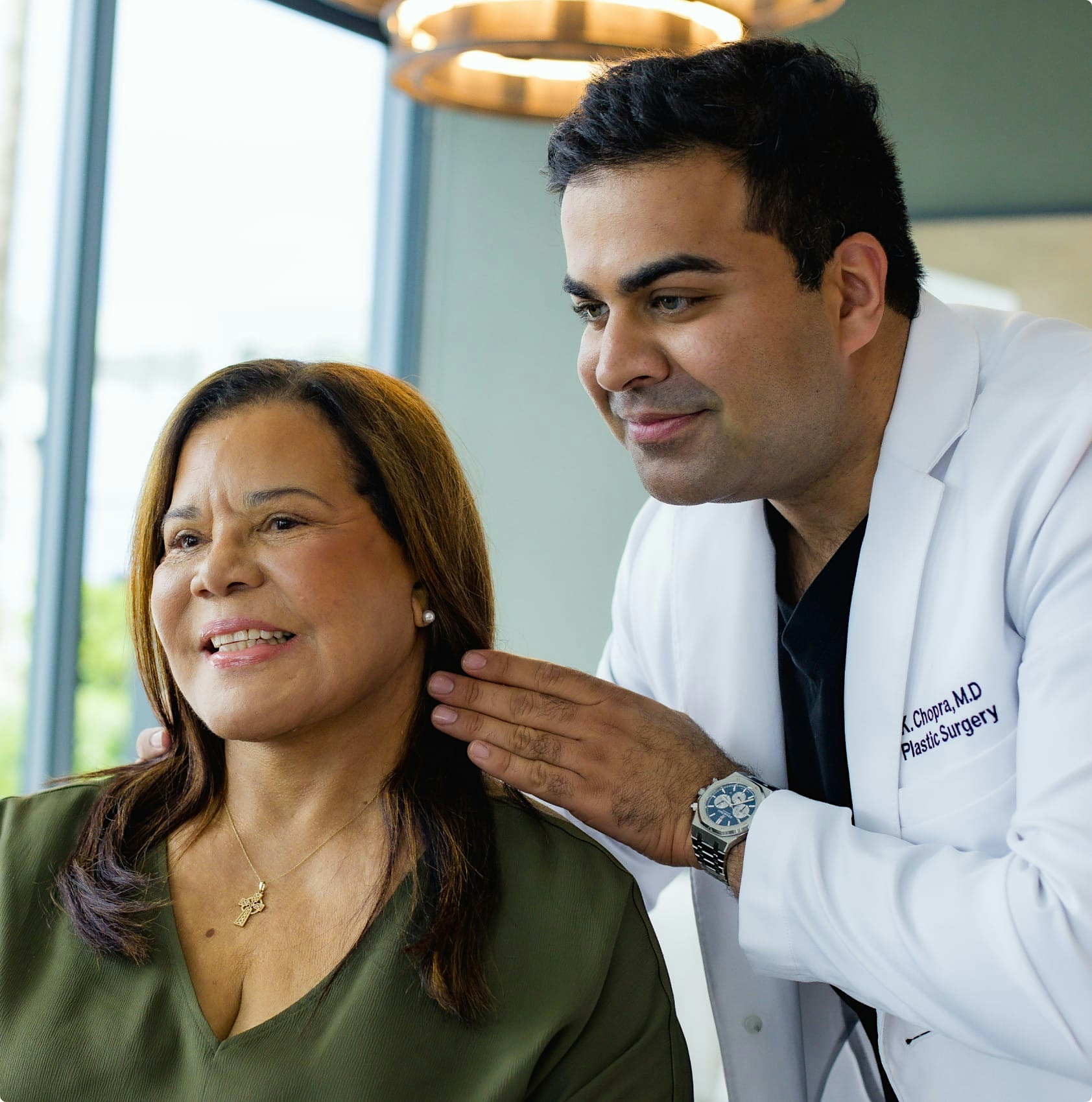


Beauty Uncompromised Request a Private Consultation


High cheekbones and low cheekbones are both determined by the shape of the zygomatic bone beneath the skin and the volume of fat sitting on top of it. Genetics set the baseline, but aging, weight changes, and bone structure can shift how prominent your cheekbones appear over time.
Dr. Karan Chopra, a board-certified plastic and reconstructive surgeon in Miami, evaluates facial structure daily as part of a practice built around facial rejuvenation and enhancement. Trained at Johns Hopkins Hospital and now a Clinical Professor of Plastic Surgery at the University of Miami, he offers surgical and non-surgical routes to change how the cheeks look, depending on a patient's anatomy and goals.
In this blog, we'll cover what actually determines cheekbone height, how to assess your own, and the surgical and non-surgical options Dr. Chopra offers in Miami to enhance or refine cheek contour.
Cheekbone height comes down to two anatomical factors working together:
Bone structure is inherited, so someone with a naturally high, wide zygomatic arch will have prominent cheekbones regardless of body weight. A person with a flatter or more recessed zygomatic bone will show a softer cheek contour even at a lean weight.
Fat behaves differently depending on age, which is why the same bone structure can look different over time:
That combination of bone shape, fat volume, and position explains why two people with similar bone structure can present very differently, and why an effective treatment plan needs to address both the skeletal frame and the soft tissue on top of it.
A quick self-assessment can reveal which category you fall into before you ever discuss options with a surgeon. Try these three checks in a well-lit mirror:
These aren’t diagnostic; think of them as a starting point for a conversation, not a substitute for an in-person evaluation. Only a hands-on exam can account for skin thickness, fat distribution, and bone angle together.
Facial harmony depends on proportion, not on hitting one universal cheekbone shape. High, sculpted cheekbones read as striking and photogenic to many people, while softer, lower cheekbones can look youthful and approachable. Neither is objectively better; both are simply different starting points.
Patients typically seek change for one of two reasons:
Dr. Chopra's approach starts with overall facial balance rather than a fixed ideal. During a consultation in his Miami office, he evaluates how the cheeks relate to the eyes, jawline, and nose so that any change supports the whole face instead of creating a mismatched feature.
Patients who want a permanent, structural change to cheek height or contour typically consider one of four surgical approaches:
None of the following treatments changes the underlying zygomatic bone. They work with the soft tissue above it, making them a good fit for patients in earlier stages of volume loss or for those who want to delay rather than replace surgical correction.
The right approach depends on whether the concern is bone structure, fat volume, skin quality, or some combination of the three, which is difficult to judge without an in-person evaluation. A consultation with Dr. Chopra typically includes a hands-on assessment of bone projection, fat distribution, and skin elasticity before any recommendation is made.
Patients traveling to Miami specifically for facial procedures are common at this practice. One patient, Elizabeth V., noted that Dr. Chopra's academic background was what convinced her to choose him for her facial surgery. That same evaluation process applies whether the goal is subtle filler refinement or a structural implant.
Few providers combine surgical and non-surgical cheek expertise the way Dr. Chopra does. He completed his plastic surgery training at Johns Hopkins Hospital, followed by a dual aesthetic and oculoplastic fellowship with Dr. Mark Codner and advanced facelift training with Dr. Bryan Mendelson, two of the most recognized names in facial rejuvenation.
Board-certified by the American Board of Plastic Surgery and recognized among Florida's Top 10 Plastic Surgeons in both 2024 and 2025, Dr. Chopra also serves as a Clinical Professor of Plastic Surgery at the University of Miami, where he trains the next generation of surgeons in the same techniques he uses on his own patients. That depth of facial anatomy knowledge is what lets him move a patient between surgical and non-surgical cheek options as their goals or life stage change.
Whether your goal is more lift, more definition, or a softer transition between cheek and jaw, Dr. Chopra can map out a plan built around your specific bone structure and facial fat distribution. A consultation at his Miami practice starts with an honest assessment of what surgery, injectables, or both can realistically achieve for your face. Schedule a consultation at Chopra Plastic Surgery to find out which option fits you.
Disclaimer: This information is provided for educational purposes only and does not replace a consultation with a board-certified plastic surgeon. Outcomes, risks, and suitability vary from patient to patient.
Sources