

Beauty Uncompromised Request a Private Consultation

Medically reviewed by Dr. Karan Chopra, MD, board-certified plastic surgeon
GLP-1 medications have helped millions lose weight fast, and a wave of those patients are now looking at a face they do not recognize. Deflated cheeks, new laxity in the lower face, and sagging in the neck are the signature of what is being called Ozempic face. The cause is mechanical: skin stretched beyond its physiologic limits for years does not snap back when the weight comes off. The fix is a rebuild, not a cream.
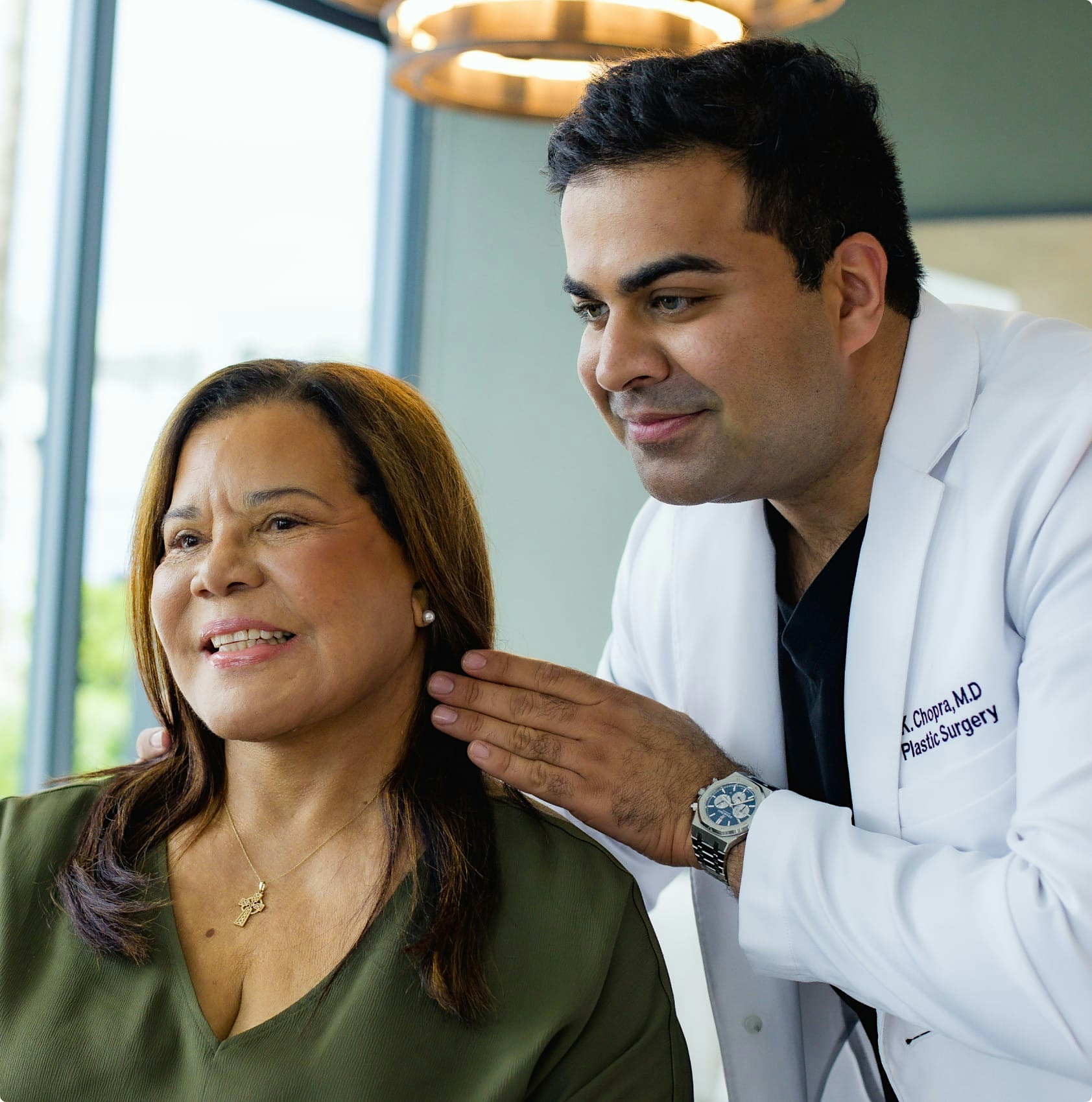
Dr. Karan Chopra is a board-certified plastic surgeon at Chopra Plastic Surgery in Miami who trained at Johns Hopkins and built his practice around facial and neck surgery. You can read more on his bio page. This article explains what Ozempic face is, why the skin does not bounce back, what rapid weight loss takes from the face, and how Dr. Chopra rebuilds it.
Ozempic face is the deflated, sagging appearance of the face and neck that follows rapid, significant weight loss, caused by a combination of stretched skin and lost facial fat.
Ozempic face is the informal name for the facial aging that follows fast weight loss. It shows up as loose skin along the jawline and neck, hollowing in the cheeks and around the mouth, and an overall deflated appearance that arrives far faster than natural aging would have delivered it.
The name comes from the GLP-1 medications driving the current weight loss wave, but the phenomenon is not new. Patients after bariatric surgery have experienced the same thing for decades. As the American Society of Plastic Surgeons notes, the changes reflect volume loss combined with sagging skin, and the right treatment depends on the patient's anatomy. What has changed is the scale: weight that once took years to lose now comes off in months, and the face shows it.
Dr. Chopra recently treated a man from Texas in his late 30s to early 40s who had lost 180 pounds. The weight was gone. What remained was laxity through the lower face and neck.
The reason is simple mechanics. While a patient carries extra weight, the skin envelope of the face and neck is stretched for a sustained period of time, beyond its physiologic limits. Skin is elastic, but elasticity has a breaking point. When the weight finally comes off, the envelope does not fully recoil. Dr. Chopra compares it to a band that was overstretched for years: it never truly regains its elasticity. The longer and further the skin was stretched, the less it snaps back, regardless of how young the patient is.
Weight loss removes fat indiscriminately. As Dr. Chopra puts it, the body does not know which fat cells were good fat cells and which were bad ones. Some of the fat in the face is what keeps you looking young. It creates the soft, plush look of youthful lips, cheeks, and jawline. When the body burns through its reserves, that fat disappears along with everything else.
The result is a double problem: loose, overstretched skin draped over a face that has also lost its youthful volume. That is exactly why single-tool fixes disappoint. Skin-tightening devices cannot restore volume, filler cannot tighten an overstretched envelope, and chasing loose skin with syringes creates its own set of issues. A real correction has to treat both.
Treating weight-loss-related facial aging means treating every factor involved, and the plan typically has two parts:
Planning both together, in the right order and often in a single surgery, is what produces a natural result. It also means one recovery instead of two, and it lets Dr. Chopra restore exactly as much volume as the lifted face actually needs.
Timing matters. The right moment for surgical correction is when your weight has stabilized. Operating in the middle of active weight loss means the face will keep changing after surgery, so results planned for one face land on another.
For patients still losing, a consultation is still worth having early. It maps what will likely need correcting and gives you a plan to execute the moment your weight levels off. For patients whose weight has been stable for several months, the rebuild can be scheduled.
The medications are not the cause. The stretch is. Any large, sustained weight gain followed by loss produces the same overstretched envelope, whether the loss came from a GLP-1, bariatric surgery, or years of diet and training. What the medications changed is the speed and the number of people arriving at this point at once. There is an upside for younger patients, though: they still have healthier elastin in the skin that remains, so when the deep structures are restored and the skin is redraped, it cooperates better than the same laxity would in a much older patient.
This article is for general education and is not medical advice. Individual results vary. Please consult a board-certified plastic surgeon about your specific situation.
Losing the weight was the hard part. If your face and neck did not come along, Dr. Karan Chopra can map out a full rebuild for you. Schedule your consultation with Dr. Chopra today. Consultations are available in person in Miami and virtually for out-of-town patients.
Ozempic face is the deflated, sagging facial appearance that follows rapid weight loss: loose skin along the jaw and neck, hollowed cheeks, and volume loss that makes the face look older than it is.
The skin envelope was stretched beyond its physiologic limits for a sustained period, like a band overstretched for years. Once elasticity is lost that way, the skin cannot fully recoil on its own.
No. Devices cannot restore lost volume, and filler cannot tighten an overstretched skin envelope. Significant post-weight-loss laxity usually requires a surgical lift combined with fat transfer.
By treating every factor involved: a deep plane facelift, a deep neck lift, or both to restore structure, plus facial fat transfer to rebuild the youthful volume the weight loss removed.
Once your weight has stabilized. Operating during active weight loss means the face keeps changing after surgery, so stability for several months is the right starting point.