

Beauty Uncompromised Request a Private Consultation


Medically reviewed by Dr. Karan Chopra, MD, board-certified plastic surgeon
Most people think a facelift is only about the jawline and jowls, but a deep plane facelift is one of the few techniques that genuinely improves the cheeks and the heavy nasolabial folds, the creases from the nose to the mouth that people spend years chasing with filler. It works by getting under the cheek fat pad and resuspending it, which softens the fold instead of just inflating around it. Because aging is both sagging and volume loss, the best results come from lifting and filling, not one alone.
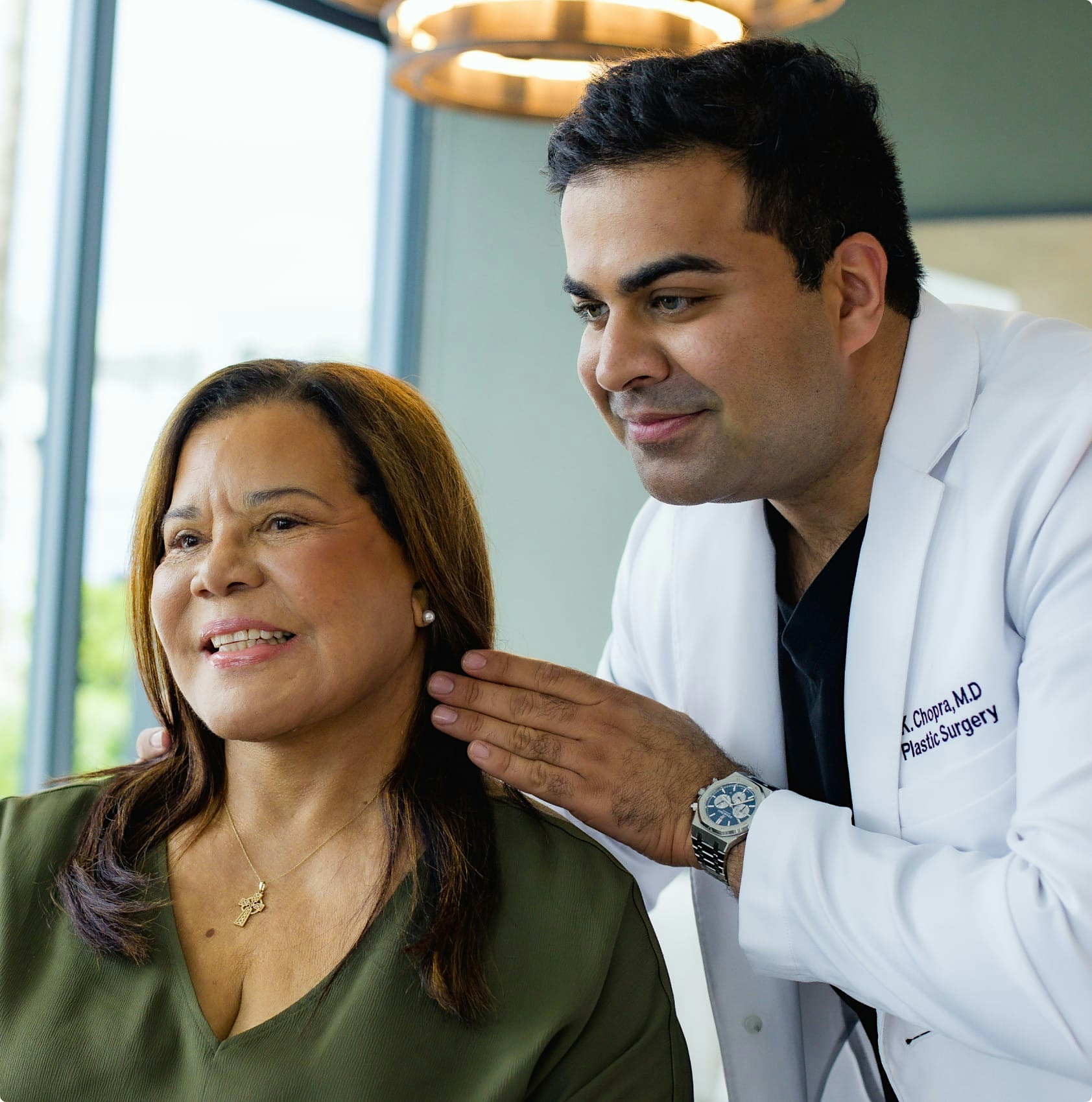
Dr. Karan Chopra is a board-certified plastic surgeon in Miami who trained at Johns Hopkins and built his practice around facial and neck surgery. You can read more on his bio page. This article explains what the nasolabial fold actually is, how a deep plane facelift improves it, why filler alone falls short, and how lifting and filling together produce a natural result.
The nasolabial folds are the creases that run from the sides of the nose to the corners of the mouth, and they deepen with age as the cheek fat pad descends and folds over them.
No. The jawline and jowls are where most people expect improvement, and a deep plane facelift delivers there, but its reach is broader. Uniquely among facelift techniques, it can dramatically improve the heavy nasolabial folds, because of where and how it works beneath the surface.
That matters, because the midface and the folds around the mouth are exactly the areas patients try to fix for years with injectables before realizing the problem is structural. A deep plane face and neck lift produces high-quality improvement in the jowls, jawline, and neck, and it is also one of the only techniques that meaningfully addresses the folds that most treatments can only mask.
The deep plane technique gets truly under the nasolabial fold, beneath the cheek mound and the malar fat pad, the pad of fat that sits over the cheekbone. By releasing and resuspending that pad, it lifts the tissue that has descended and folded over the crease, which reduces the fold itself. The surgeon works in the layer beneath the skin, part of the connected fascial system the NIH National Library of Medicine describes, so the correction comes from repositioning structure rather than stretching the surface.
There is an important distinction here that Dr. Chopra makes with every patient. The crease is normal. Everyone has it, even children have it when they smile. What deepens with age is the folding over of tissue on top of that crease. A deep plane facelift is designed to reduce that folding, not to erase a natural crease, which is why the result looks refreshed rather than artificial. A face with no nasolabial crease at all would look stranger than one with a softened, age-appropriate fold.
Filler adds volume, and there is a real role for volume, because facial aging usually includes some volume loss in this area. But filler alone does not lift descended tissue. When an injector tries to fill a fold that is caused by sagging, the amount required keeps climbing and the face starts to look overfilled while the underlying droop remains. The fold is being packed from below rather than the cause being corrected.
Dr. Chopra frames the correct approach simply: lift and fill. You do not want to just fill, and you do not want to just lift. You want to treat the actual problem, which for most patients is a combination of soft-tissue sagging and volume loss. The lift repositions what has descended, and targeted facial fat transfer restores the volume that has genuinely been lost. Treating only one half of the problem is why so many single-tool attempts disappoint.
Injectables do not disappear from the plan, they return to their proper role. Once a facelift has restored position, fat or filler can refine specific areas that remain deflated, used as precise finishing tools rather than as a structural fix. Fat has the added advantage of being your own living tissue, so it looks and moves like you and avoids the inflated look that too much filler can create.
The order is what matters: structure first, volume second. Trying to reverse that order, chasing sag with volume, is what leads to the overfilled faces people are trying to avoid in the first place. When the sequence is right, a small, well-placed amount of volume is often all a lifted face needs.
Yes, and this is one of its under-appreciated strengths. Because the technique resuspends the malar fat pad over the cheekbone, it restores midface fullness at the same time it softens the folds. Patients who thought they needed cheek filler often find that repositioning their own descended cheek tissue gives them back the fullness they had, in the place it originally sat. It is the difference between rebuilding a cheek with product and returning a cheek to where it belongs.
Good candidates are patients bothered by deepening nasolabial folds, flattening cheeks, and a heavier lower face, whose aging reflects both descent and volume loss. An in-person evaluation determines how much of your concern is sagging versus lost volume, which decides how much lifting and how much filling your face actually needs. The answer is almost always some of each, and the balance is different for every face.
Yes, because the correction is structural. Repositioning the descended cheek fat pad restores the midface at its foundation rather than masking the fold from the surface, and a deep plane result commonly lasts ten to fifteen years. Any fat added to restore lost volume is your own living tissue, so it integrates and behaves like the rest of your face. Aging continues, so maintenance such as good skin care and periodic treatments helps preserve the result, but the lift itself is a durable change, not a temporary fill.
Thread lifts and liquid, or filler, facelifts try to mimic a lift without surgery, but they cannot reposition the deep cheek structures responsible for a heavy fold. Threads pull on tissue temporarily, and filler adds volume on top of the problem, so both tend to fade or, with repeated filler, look overfilled. A deep plane facelift treats the cause by resuspending the malar fat pad, which is why it improves the folds and cheeks in a way non-surgical shortcuts cannot match.
Recovery follows the usual deep plane course: about a week of mild bruising, a second week of swelling, and social comfort for most patients around three weeks. Because the technique preserves the connections between skin and muscle, bruising and swelling tend to be milder than with other methods, and any fat grafting done at the same time heals alongside the lift rather than adding separate downtime.
This article is for general education and is not medical advice. Individual results vary. Please consult a board-certified plastic surgeon about your specific situation.
If you have spent years filling your folds and cheeks, a consultation can tell you whether the real answer is structural. Dr. Karan Chopra will assess how much you need to lift versus fill. Schedule your consultation with Dr. Chopra today. Consultations are available in person in Miami and virtually for out-of-town patients.
A deep plane facelift can significantly soften heavy nasolabial folds by lifting and resuspending the cheek fat pad that has folded over the crease. It reduces the folding rather than erasing the natural crease, which everyone has, so the result looks refreshed rather than flat.
Because filler adds volume but does not lift descended tissue. When the fold is caused by sagging, filling it requires ever-increasing amounts and tends to look overfilled while the droop remains. Sagging needs a lift, not more volume.
Yes. The technique works beneath the malar fat pad over the cheekbone and resuspends it, which restores midface fullness and improves the folds at the same time. Many patients find they no longer need cheek filler afterward.
Often, yes, but in the right order. Aging is usually sagging plus volume loss, so many patients benefit from lifting the descended tissue first and then restoring any lost volume with fat transfer, with filler reserved as a finishing tool.
Yes. The goal is to reduce the tissue that folds over the crease with age, not to remove the natural crease that appears when you smile. Preserving that crease is part of what keeps the result looking like you.