

Beauty Uncompromised Request a Private Consultation

ChatGPT and other AI tools can explain what a deep plane facelift is, but they cannot examine your face, assess your skin and anatomy, or tell you which approach fits you. Their answers reflect the general consensus of published information, not a surgeon's hands-on experience. Use AI for background reading, then bring the questions that depend on you to a consultation.
Dr. Karan Chopra of Chopra Plastic Surgery in Miami holds a faculty appointment at the Herbert Wertheim College of Medicine at Florida International University. Some of his patients now arrive having already asked a chatbot about facelifts. This article covers what AI gets right, where it falls short, and how to use it well before you meet a surgeon.
A deep plane facelift is a facelift technique that lifts the skin and the deeper facial layer, called the SMAS (a sheet of connective tissue and muscle beneath the skin), together as one unit after releasing the ligaments that hold sagging tissue in place. This definition is widely published, so AI tools can usually repeat it accurately.
For general background, AI is a reasonable starting point. It can explain:
"AI has never done a facelift," Dr. Chopra says. The limits are built into how the technology works.
A large language model produces answers by drawing on patterns across everything it was trained on. In Dr. Chopra's words, the answer is "an average of everything that's known about things." That makes AI good at consensus and weak at judgment. It describes the typical patient, the typical technique, and the typical recovery, and no one is the typical patient.
A facelift plan starts with a physical exam. Mayo Clinic describes a facelift consultation as a visit in which the surgeon looks at your bone structure, face shape, facial fat, and skin, and photographs your face from several angles. Even when you upload a photo, an AI tool cannot feel how thick your skin is, how freely the tissue moves, or what sits beneath the surface of your neck.
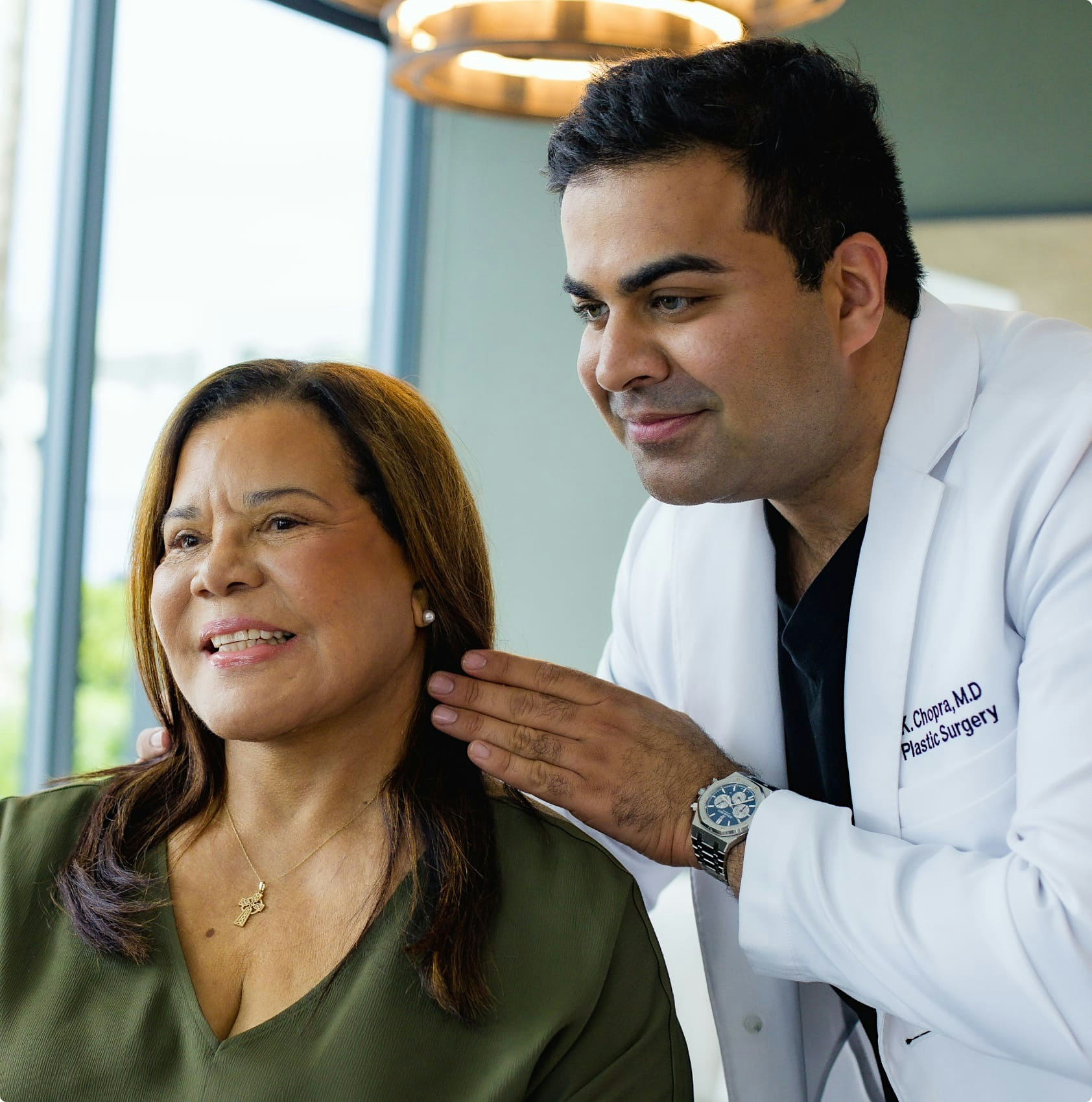
Skin thickness and elasticity vary from person to person and from one area of the face to another. Dr. Chopra has published original research on facial skin thickness, and having the surgeon check your skin in person is one of the things he most wants a consultation to accomplish.
Jowls and neck fullness can come from loose skin, descended tissue, deep fat, or muscle, and in the neck, from the glands under the jaw. The right procedure depends on which one is responsible, and that is determined by an exam, not a description.
Prior surgery, fillers, weight changes, nicotine use, and medical conditions all change the plan. Dr. Chopra compares earlier procedures to paint already on the canvas: each layer affects what can be done next.
The term describes the layer of the face where the surgeon works, not a single recipe. How much is released, how the neck is handled, and how the result is shaped can differ from surgeon to surgeon. That is why a surgeon's training and daily experience matter more than the label.
In a 2024 study in Aesthetic Surgery Journal Open Forum, the study's senior author, a plastic surgeon, graded the free version of ChatGPT and Google Bard on simulated patient questions about facelift, rhinoplasty (nose surgery), and brow lift. ChatGPT scored 6.7 out of 10 for accuracy and 6.6 for comprehensiveness, and none of its responses included references. The authors described the performance of these tools as imperfect.
AI tools have changed since those models were tested in 2023, and newer versions may perform differently. The limit that does not change is the physical one: a chatbot has never examined a patient or performed an operation.
Dr. Chopra has noticed a pattern. Patients coached by AI tend to arrive with obscure or redundant questions, many of which have no effect on the result or would have been covered anyway. The time spent on them is time not spent on your own face.
That is no criticism of doing research. It is about where limited face-to-face time is best spent.
Asked what he wishes AI told patients, Dr. Chopra gave a three-part answer: do your reading with AI, spend the consultation with the surgeon, and send later questions to the office.
Learn the vocabulary and the general outline so the basics do not take up your appointment. Treat anything specific, such as cost, candidacy, or expected results, as a question to confirm with a surgeon.
Dr. Chopra wants consultation time used on three things: having the surgeon check your skin, hearing what the surgeon hopes to achieve, and learning what you can do to improve your result. Our consultation process page explains what to expect.
The exam covers skin quality, facial structure, and the neck, and it is the basis for every recommendation that follows.
A surgeon should be able to describe the goal for your face in plain language, including what will change and what will not.
Preparation is one of the few parts of surgery that you control.
Dr. Chopra asks patients to stop nicotine in every form for four weeks before surgery and to hold a stable weight for at least three months beforehand. Your pre-operative instructions cover medications and other specifics.
Wellness products are easy to forget because they do not feel like medication, so list everything you take. Dr. Chopra asks patients to tell their surgeon early about peptides (wellness compounds such as BPC-157). He recommends pausing all peptides one week before surgery and resuming them once you are fully healed, for a more predictable recovery.
Stay off nicotine for another four weeks, and keep your weight steady while you heal. A steady weight matters most when fat grafting is part of the plan, because the transferred fat needs time to establish itself.
Questions keep coming after a consultation. Dr. Chopra wishes AI told patients to "text the doctor's office" when a concern comes up, because the nurses and surgeons there do this work every day and can answer for your specific case.
Use AI and a surgeon, in that order. AI can prepare you for the conversation, and a qualified surgeon should guide it. Look for certification by the American Board of Plastic Surgery, focused training in facial surgery, and a practice that performs facelifts routinely. Dr. Chopra trained in plastic surgery at Johns Hopkins, completed fellowship training in aesthetic and oculoplastic (eyelid and eye-area) surgery, and concentrates his practice on the face and neck.
An AI tool can explain what a deep plane facelift is. Dr. Chopra can tell you whether it is right for you, after examining your skin and listening to your goals. If you have done your reading and are ready for specifics, our team at Chopra Plastic Surgery is glad to help. Schedule your consultation with Dr. Chopra in Miami today.
This article is for general education and is not medical advice. Individual results vary. Please consult a board-certified plastic surgeon about your specific situation.
No. Candidacy depends on a physical exam of your skin, facial structure, and neck, along with your medical history. AI can describe the typical candidate in general terms, but it cannot assess your tissue or weigh your personal risks. Only a consultation with a qualified plastic surgeon can answer that question for you.
It is often accurate on general facts, with gaps. In one 2024 study that tested the free version of ChatGPT in 2023, the study's senior author, a plastic surgeon, rated its answers on facial aesthetic surgery at 6.7 out of 10 for accuracy and 6.6 for comprehensiveness, and its responses did not cite sources. Newer tools may do better, but none can examine you.
AI tends to give the average answer. It can describe the deep plane facelift as if it were one standardized operation, it describes a generic patient, and it cannot account for your skin, anatomy, or history. It also cannot tell you how a specific surgeon performs the procedure, which is one of the biggest factors in the result.
Read the basics first so that you understand the vocabulary. Then use the appointment for what only a surgeon can provide: an exam of your skin, a clear description of the intended result, and specific advice on what you can do to improve your outcome. Bring a list of your medications, supplements, and prior procedures.
Yes, as a starting point. AI is useful for learning terms and organizing your thoughts. Confirm anything that affects a decision, such as candidacy, technique, cost, or recovery, with a board-certified plastic surgeon. After your consultation, send follow-up questions to the surgeon's office instead of relying on a chatbot's general answer.