

Beauty Uncompromised Request a Private Consultation


Facelift recovery follows a predictable arc for most patients: about one week of mild bruising, a second week where swelling is the main feature, and social comfort around week three. Discomfort is usually mild enough to manage with acetaminophen. Visible healing happens mostly in the first month, and subtle refinement continues for several months after that.
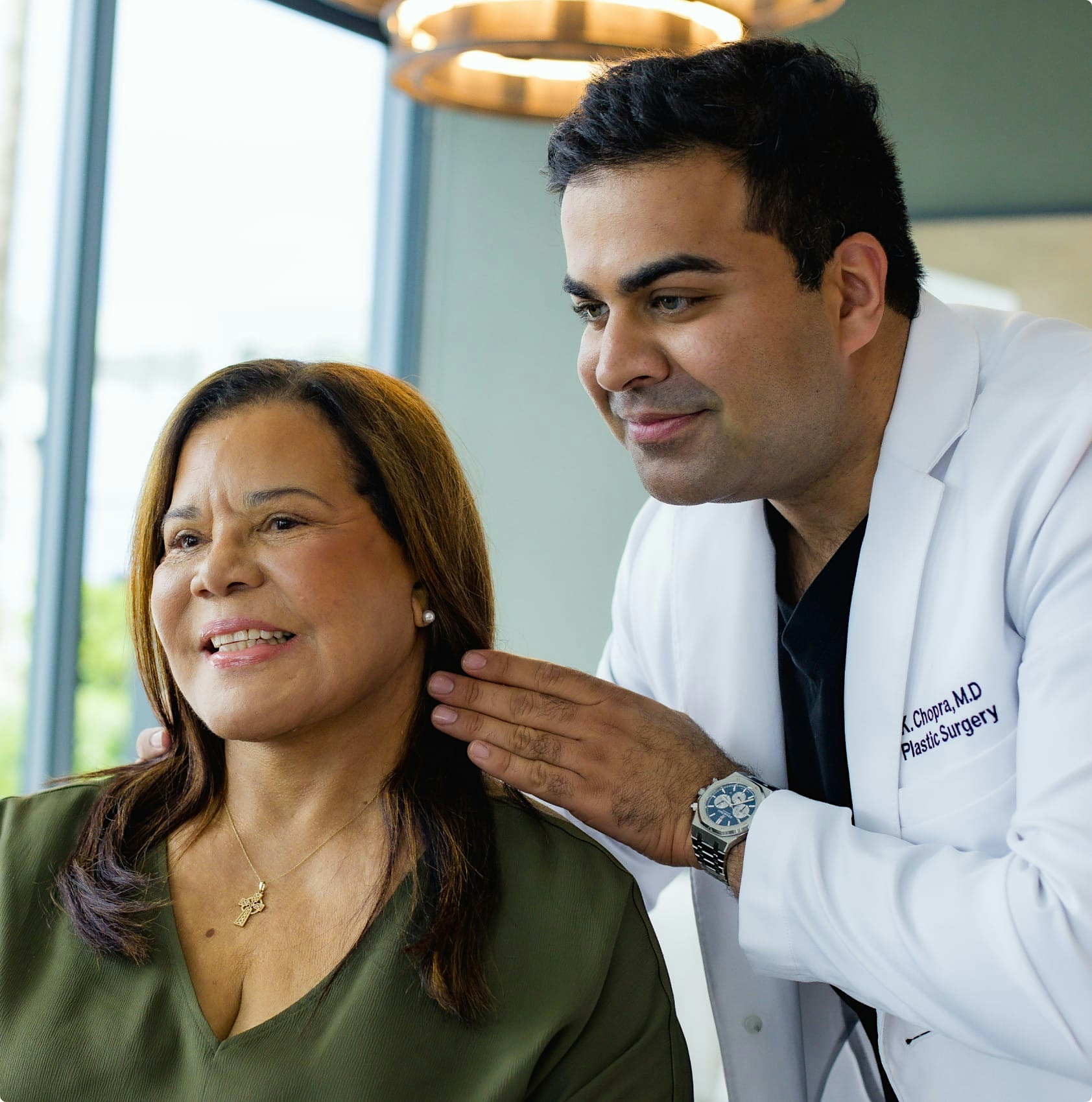
Dr. Karan Chopra is a board-certified plastic surgeon in Miami who trained at Johns Hopkins and focuses his practice on the face, with fellowship training in deep plane facelift technique. You can read more on his bio page. This article walks through recovery week by week, from the first night through the months that follow, and ends with ways to make healing smoother.
A facelift is a surgical procedure that lifts and repositions the deeper tissues of the face to restore a more defined, rested contour.
A deep plane facelift generally takes about four hours. Because the technique works beneath the muscle layer and handles tissue gently, most patients wake up more comfortable than they expected and are able to walk soon after surgery.
The first night is the most sensitive stretch of recovery, which is why patients at Chopra Plastic Surgery are provided an overnight caretaker in the recovery suite. A member of the care team stays with you through the night, monitors your comfort, and handles the small things, like keeping your head elevated and your first doses of medication on schedule, so you and your family do not have to manage that night alone.
Week one is mostly about rest and mild bruising. In Dr. Chopra's practice, most patients describe the discomfort as manageable with acetaminophen (Tylenol) rather than stronger medication, and many are surprised at how uneventful the first days feel.
During this week, expect to keep your head elevated, take short walks around the house to support circulation, and attend an early follow-up visit so the team can check your incisions. Our team also calls you daily during the early recovery period, which is how small questions get answered before they become worries. Bruising typically peaks early in the week and starts fading before it ends.
By the second week, bruising gives way to swelling as the main feature. This is the stage that surprises people most: you feel fine, but the mirror still shows a fuller, softer version of your result. That is normal. Swelling is not the outcome; it is the tissue healing around the outcome.
Many patients return to desk work and everyday errands during this week, often with the help of a scarf, collar, or light makeup once the team clears it. Strenuous activity stays off the table a while longer, and it is worth following that instruction closely, because elevated blood pressure works against healing tissue. The Mayo Clinic's facelift overview describes a similar early recovery pattern of bruising and swelling that improves over the first weeks.
Around week three, most patients reach what Dr. Chopra calls restaurant ready: comfortable sitting across a dinner table without feeling that anyone is studying their face. Residual swelling is still there, but it reads as subtle fullness rather than surgery.
If you have a specific event on the calendar, a wedding, a reunion, or professional photos, it is wise to build in extra margin beyond week three, closer to four to six weeks, so the remaining swelling has time to quiet down. The American Society of Plastic Surgeons notes that recovery timelines vary from patient to patient, so treat every milestone here as a typical pattern rather than a promise.
From the one-month mark onward, changes are gradual and mostly invisible to everyone but you. Deep swelling continues to resolve over several months, which is why the jawline and neck keep refining long after you have returned to normal life. Patches of numbness or tightness are common and improve slowly as small nerves recover.
Incision lines follow their own timeline. They are typically pink at first and mature over many months, often up to a year, fading as they settle. Consistent sun protection during this period is one of the simplest things you can do to protect both your scars and your overall result.
Most of what determines a smooth recovery is set up before and just after surgery:
How long until I look normal after a facelift?
Most patients feel socially comfortable around week three, when bruising has resolved and swelling has softened into subtle fullness. Looking your true best takes longer, because deep swelling continues resolving for several months. For an important event, plan four to six weeks of margin. Timelines vary by patient, technique, and how closely aftercare instructions are followed.
How painful is facelift recovery?
Usually less than people fear. In Dr. Chopra's practice, most patients describe Tylenol-level discomfort rather than significant pain, especially with a deep plane technique that handles tissue gently. Tightness and numbness are more common complaints than pain itself. If pain ever escalates instead of easing, that is a reason to call your care team promptly.
When can I exercise after a facelift?
Short, gentle walks are encouraged within days because they support circulation. Strenuous exercise, heavy lifting, and anything that raises your heart rate significantly should wait until your surgeon clears you, typically a few weeks in. Returning too early raises blood pressure in healing tissue, which increases the risk of swelling and bleeding.
When can I drive again?
Once you are off any sedating medication, can turn your head comfortably, and feel alert enough to react normally, which for many patients happens within the first week or two. Your care team will confirm timing at your follow-up visits rather than guessing from a calendar.
Do out-of-town patients recover differently?
The healing itself is the same; the logistics differ. Out-of-town patients begin with a telemedicine consultation, then plan to remain in Miami through the early stretch of recovery, commonly the first week or two, so follow-up visits happen in person before travel home. Our team coordinates those details in advance so the trip stays organized.
The best recoveries are planned before surgery day, and that planning is part of what you get at Chopra Plastic Surgery: an overnight caretaker for the first night, daily calls in the early days, and a team that answers before questions become worries. Schedule your consultation with Dr. Chopra in Miami today.
This article is for general education and is not medical advice. Individual results vary. Please consult a board-certified plastic surgeon about your specific situation.