

Beauty Uncompromised Request a Private Consultation



Facelift procedures have come a long way from the pulled, overdone results that once defined the category. Today, one of the most requested techniques is the ponytail facelift. At its core, this technique is designed to lift and reposition the lateral and midface vertically. Doing so mimics the naturally elevated look of a high ponytail, without the more extensive tissue work involved in a traditional facelift. The result is a refreshed, defined appearance that tends to look natural rather than operated on.
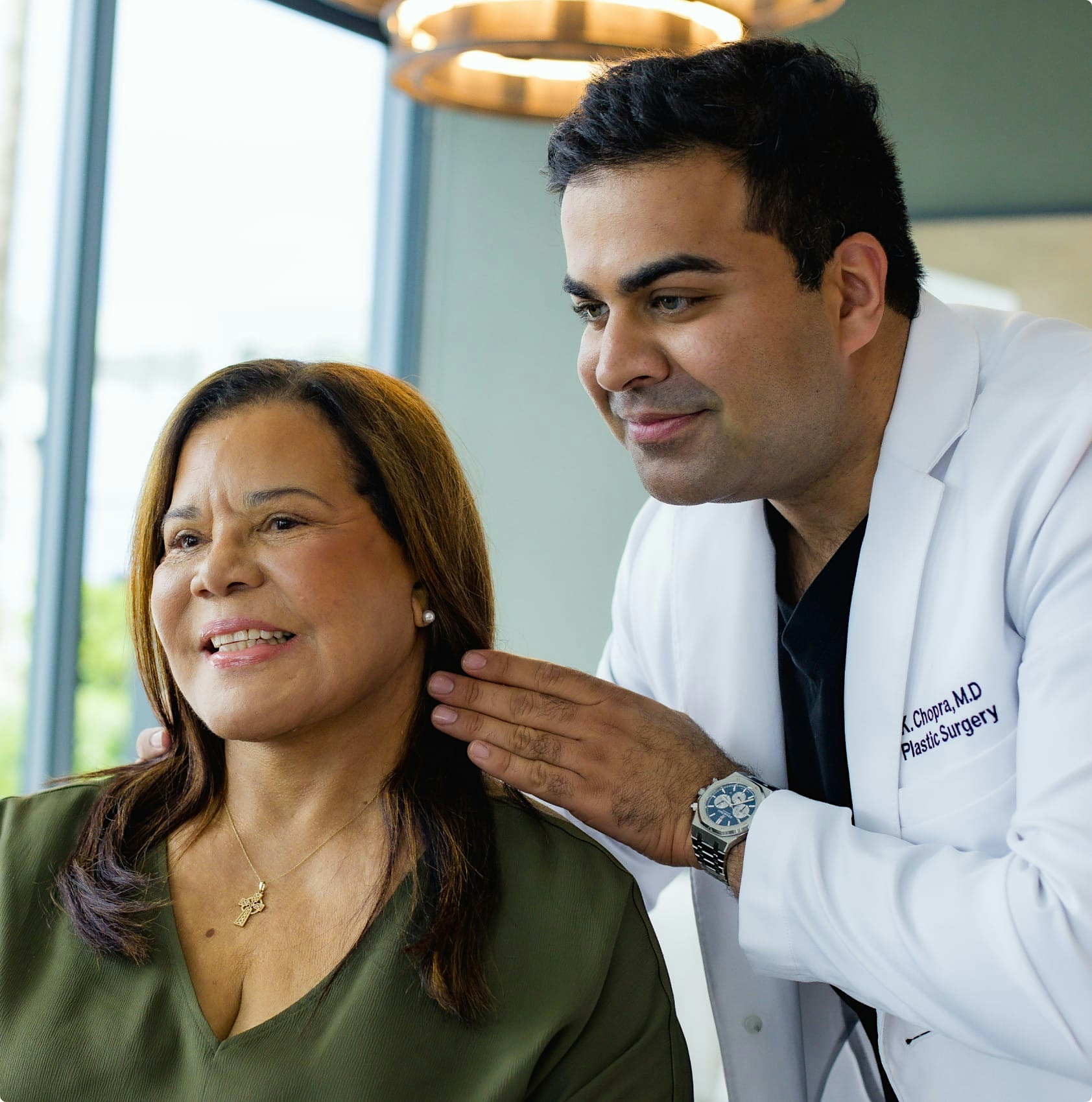
Dr. Karan Chopra’s training at Johns Hopkins Hospital, paired with a fellowship under Dr. Mark Codner—a globally recognized leader in facial plastic surgery—and a practice dedicated exclusively to the face and neck, means he brings a depth of facelift expertise that few surgeons can match. Here is what Dr. Chopra wants patients to understand before choosing between these two approaches.
The ponytail facelift gets its name from the naturally taut, lifted appearance created when hair is pulled into a high ponytail. Surgically, it focuses on vertical repositioning of the lateral face and midface, producing improved cheekbone definition, a cleaner jawline, and smoother skin, but without the deeper tissue work of a full facelift. It is generally considered a less extensive procedure, making it well-suited for patients in the earlier stages of facial aging who want meaningful improvement without committing to a more comprehensive correction.
Here are some of the key benefits associated with the ponytail facelift:
A traditional facelift, also called a rhytidectomy, is a more comprehensive procedure that addresses deeper tissue layers across a broader area of the face and neck. Where the ponytail facelift focuses on vertical surface lifting, a traditional facelift repositions the underlying facial musculature and connective tissue, or structures that have shifted significantly over time and require deeper correction.
It is the more appropriate choice for patients with more advanced signs of aging, including pronounced jowling, significant neck laxity, or deep folds that a lighter lift technique would not fully resolve.
Its main benefits include the following:
The ponytail facelift and traditional facelift are both surgical procedures designed to restore a more youthful, refreshed appearance by addressing the structural effects of facial aging. Both techniques can improve facial laxity, enhance jawline definition, and create results that go far beyond what non-surgical treatments can achieve.
While they share the same overall goal, the two procedures differ in the degree of correction they provide, the areas they address most effectively, and the types of patients who tend to benefit from each approach.
|
Feature |
Ponytail Facelift |
Traditional Facelift |
|
Primary Goal |
Subtle lifting and rejuvenation |
Comprehensive facial rejuvenation |
|
Best For |
Mild to moderate signs of aging |
Moderate to advanced facial aging |
|
Treatment Areas |
Primarily the upper face, cheeks, and midface |
Midface, jawline, lower face, and often the neck |
|
Degree of Lift |
More subtle enhancement |
More significant repositioning of facial tissues |
|
Incisions |
Smaller, strategically hidden incisions |
Longer incisions concealed around the ears and hairline |
|
Neck Improvement |
Limited |
Significant improvement when combined with neck lifting techniques |
|
Results |
Refreshed, lifted appearance |
Dramatic yet natural-looking rejuvenation |
|
Longevity |
Generally shorter-lasting |
Typically longer-lasting due to more extensive correction |
Regardless of which technique is chosen, both procedures:
This is the question a consultation is designed to answer, and Dr. Chopra takes it seriously because recommending the wrong procedure for a patient's degree of aging does them no favors.
As a general guide, a ponytail facelift tends to be the better fit for patients who:
A traditional facelift is often the better option for patients who:
Of course, age is only one piece of the puzzle. During your consultation, Dr. Chopra evaluates the location and severity of facial laxity, skin quality and elasticity, facial structure, and your personal aesthetic goals to determine which approach will create the most natural and balanced result.
Some patients fall somewhere between the two categories, in which case Dr. Chopra may recommend a customized or hybrid approach that combines elements of both techniques to achieve the best possible outcome.
The answer starts with a personal consultation. Dr. Chopra will evaluate your facial anatomy, discuss your goals, and recommend the approach that makes the most sense for where you are now and where you want to be long-term. Schedule your consultation with Chopra Plastic Surgery in Miami today.
This information is provided for educational purposes only and does not replace a consultation with a board-certified physician. Outcomes, risks, and suitability vary from patient to patient.